
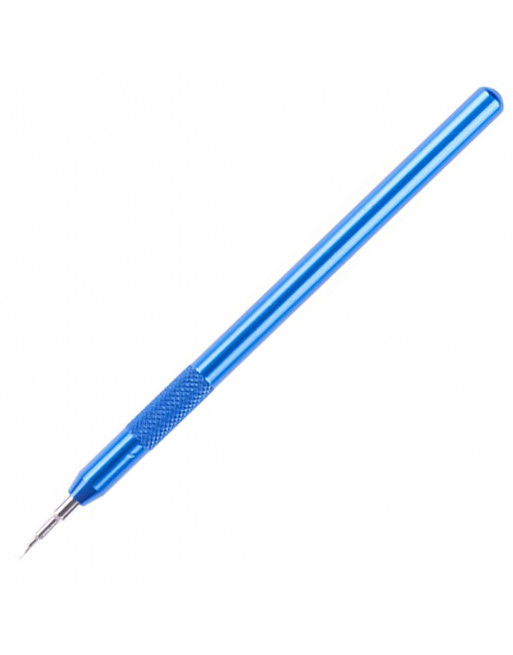
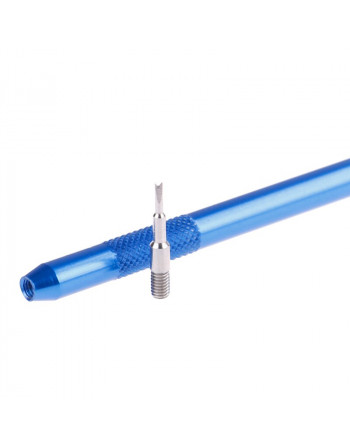
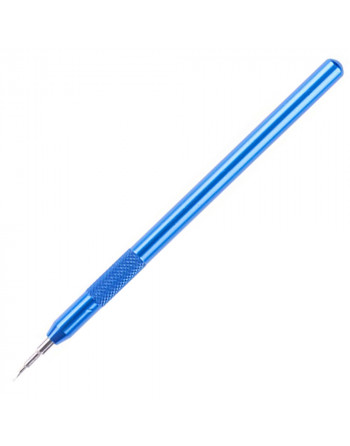
Precision stainless steel positioning awl with interchangeable tip. Handles spring bars on leather, plastic or silicone watch straps.
 100% Secure Payment
Payment through secure platforms.
 Delivery policy
Fast tracked shipping. Free shipping from €29!
The precision positioning awl is a slim watchmaker accessory designed to handle spring bars on leather, silicone, plastic and rubber straps. Forged from blue-tempered stainless steel, it is the small, sharp companion that turns a tense five-minute strap change into a relaxed thirty-second job, without scratching the lugs, without losing a tiny spring bar inside a sofa cushion and without forcing parts that were never meant to be forced.
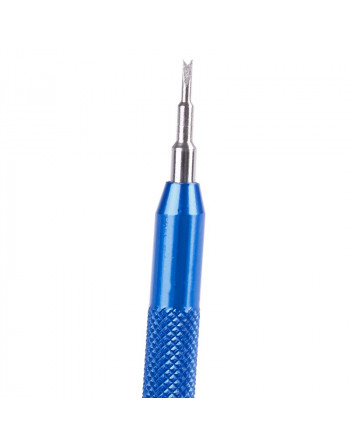
This awl is dedicated to the manipulation of spring bars — the small spring-loaded pins (also called watch pins) that hold the strap inside the lugs of the case or inside a folding clasp. Its slender body ends in a sharply ground tip with a small lateral notch. That notch is what catches the shoulder of the spring bar, lets you compress the bar inwards and frees the strap. The opposite end carries a fine pure point, useful to push a straight bar out of its housing or to clear dust from a lug hole before refitting a new bar.
The blue colour comes from the heat treatment of the stainless steel: the tempering process not only tints the metal, it also hardens the tip so it keeps its geometry over hundreds of strap changes. Stainless steel was chosen for two reasons: it resists corrosion from skin contact and from the small amount of moisture left on a strap, and it is hard enough to engage a steel spring bar without burring or rolling at the tip. Compared with chromed or nickel-plated awls, a tempered stainless tool ages far better.
The awl is sized to slide comfortably between the strap and the inside of the lug, even on watches with a tight 18 mm lug spacing or with low clearance such as some Tudor and Tissot dress models. The body itself stays slim so your hand never blocks the line of sight on the bar.
Reach for this awl every time a strap needs to come off or go back on a case held by spring bars. Concretely: replacing a worn leather strap on a dress watch, swapping a silicone strap on a smart watch, fitting a NATO on a vintage diver, separating a folding clasp from a rubber strap to clean it. It is also the right tool when a spring bar has slipped half-out and the strap rattles — you simply compress the loose shoulder and re-seat the bar in the lug hole.
It is not the right tool for screwed bracelets — those found on most Rolex Submariner, GMT-Master, Omega Seamaster Diver 300M, Tudor Black Bay and Breitling Navitimer references. For those, a screwdriver such as the BERGEON 7260 is required. It is also not designed to drive friction pins through metal bracelet links — that is the job of a pin punch (Stiftaustreiber, cacciaspine).
This awl is manufactured to the standards expected of mid-range watchmaking tools. The blue tempering colour is a genuine indicator of heat treatment, not a paint or coating; the hardness it produces is comparable with the tip steel of Bergeon equivalents at a fraction of the price. Each tip is inspected for concentricity and notch geometry before packaging. With reasonable use — meaning no prying on screwed bracelets and no use as a screwdriver — the working life of the tool runs into the thousands of strap changes.
No. Rolex Oyster, President and Jubilee bracelets use screwed link pins, not spring bars. For those bracelets the correct reference is the BERGEON 7260. The awl is still useful, however, on the rubber Oysterflex strap of a Rolex Yacht-Master, which is attached to the case via spring bars.
Yes. Swatch and Flik Flak watches use straight bars; the fine point on the opposite end is exactly designed to push a straight bar through its housing from one side to the other.
Not if used correctly — the notched tip engages the spring bar shoulder, not the lug. If you slip and contact a polished lug, the stainless steel can leave a very fine mark; working slowly and keeping the awl parallel to the bar prevents that.
Precision stainless steel positioning awl with interchangeable tip. Handles spring bars on leather, plastic or silicone watch straps.