
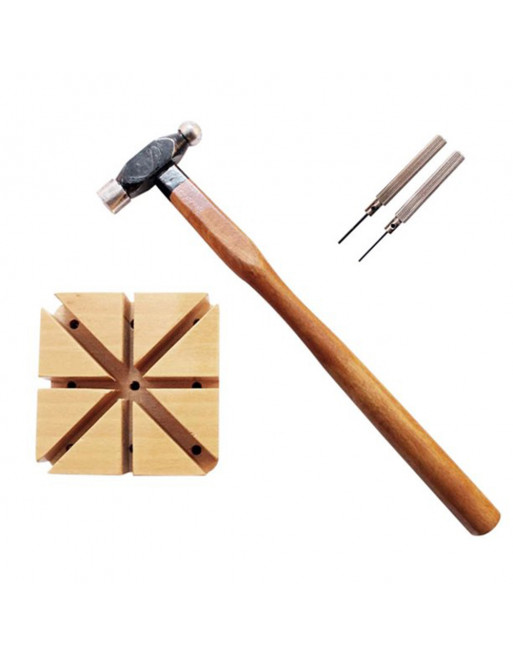
Premium 6-tool kit for watch bracelet repairs: wooden watchmaker hammer, wooden support block and 2 manual pin punches included.
 100% Secure Payment
Payment through secure platforms.
 Delivery policy
Fast tracked shipping. Free shipping from €29!
This watch bracelet repair kit gathers in one set the six essential tools needed to shorten or repair a steel bracelet at home: a wooden support block, a watchmaker's hammer with wooden handle, two manual pin punches and four spare tips. It is a coherent, ready-to-use bundle for anyone tired of bringing every steel bracelet to a jeweller for a five-minute job.
The kit was put together to cover the full workflow of metal bracelet resizing in a single purchase. Each piece complements the others. The wooden block holds the bracelet on its edge and provides exit slots aligned with the pin holes. The watchmaker's hammer delivers controlled taps. The two pin punches cover the most common pin diameters (0.80 mm and 1.00 mm). The four spare tips double the working life of the punches and ensure that a snapped tip never stops a job halfway.
Beyond the steel bracelet workflow, the manual pin punches also work on straight bars found on Swatch and Flik Flak watches, as covered in our dedicated guide. The result is a kit that fits both watch enthusiasts and small workshops where occasional bracelet work needs to be reliable.
Use the kit whenever a steel bracelet needs adjustment — typically when a freshly bought watch is too loose or too tight, or when transferring a bracelet between two watches. It also covers small repairs: replacing a broken pin, freeing a stuck pin, or swapping a clasp. The watchmaker's hammer is sized to deliver the controlled energy these jobs require — heavier hammers would drive pins too far and damage the link.
It is not for screwed bracelets (Rolex, certain Omega, Breitling) which require the BERGEON 7260 screwdriver, and it is not for leather or rubber strap changes which are done with a positioning awl.
The set is produced as a coordinated kit: the block, hammer and punches are dimensioned to work together. The hammer has a steel head with the right inertia for watch work, mounted on a hardwood handle of 20.5 cm overall for a comfortable swing. The pin punches use hardened steel tips, and the four spare tips ensure long-term usability without sourcing additional consumables. With normal care the kit lasts many years.
No. Rolex Oyster, President and Jubilee bracelets are screwed and require the BERGEON 7260. The kit covers friction-pin steel bracelets such as Seiko, Citizen, Tissot, Casio and fashion-brand watches.
Yes. The straight bars used by Swatch and Flik Flak can be pushed out with the same pin punches; our online guide explains the procedure.
Yes. Replacement tips are sold separately in our store and follow the same threading standard as those supplied with the kit.
Hold the punch perfectly vertical at all times. Light taps to seat the tip, then increase force gradually. If a pin refuses to move, a drop of penetrating oil and a few minutes' wait usually free it. Old split pins can break in two — drive each half out separately. The hammer's head should always meet the punch top dead centre; a glancing blow bends the punch shaft. Store the wooden block away from humidity to prevent warping, and keep the spare tips in a labelled small box so they are not lost.
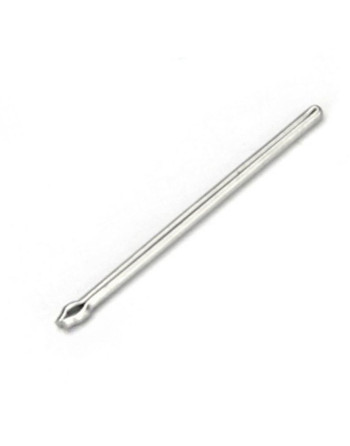
Quality slotted pin for steel watch bracelets, sold individually. Available in every size and diameter to size or repair metal straps.
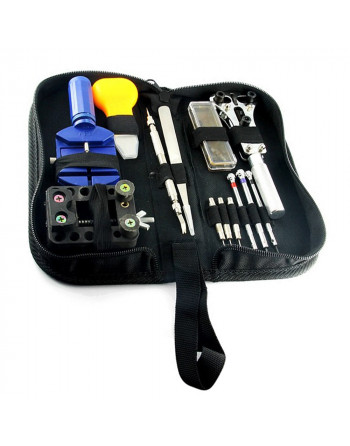
Roll-up tool case containing 12 watchmaker accessories to repair almost any type of watch.
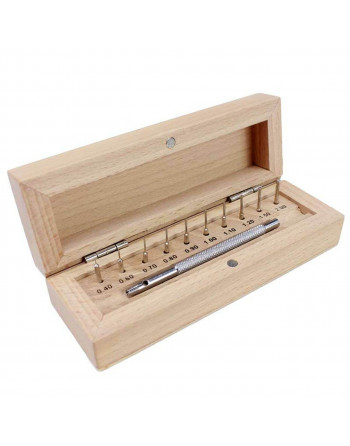
Professional manual watch pin punch in wooden case with 10 interchangeable tips, Ø 0.40 to 2.00 mm. Ideal for fine watch repair.
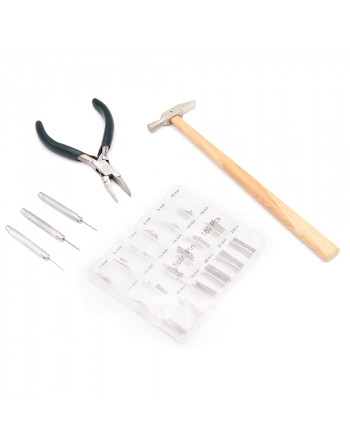
Complete kit with 1 hammer, 1 flat plier, 3 manual pin punches, 1 box of 180 slotted pins (5 to 22 mm) and 1 support block. Removes and refits split pins.
Premium 6-tool kit for watch bracelet repairs: wooden watchmaker hammer, wooden support block and 2 manual pin punches included.